We can moderate Climate Change. Change the climate…for humanity and nature

Jeff & Susan • June 2, 2021

One true sentence,” E.Hemmingway 

Our Economics allows fossil industries to sacrifice Humans and Nature for profit. This is slow suicide.   The captains of fossil industries and other industries that have gradually become destructive of Humans and Nature over the centuries, have developed into the ultimate and perfect products of Capitalism. Asking Countries and investors to ”divest from fossil fuels”, as Greta Thunberg so movingly pleads, is like asking lions to stop eating meat or locust to stop devouring crops.  

Within the confines of Capitalist economies there is no momentum toward preservation and diversity. There is only motive to compete for profit. The symptoms of this process are everywhere. We know them. We live with them from our point of awareness to death. We participate in them, to different degrees, throughout our lives, because it is our present survival system and we are trained from birth into the behaviors that sustain this economic system. To step away from this training is at the very least a kind of vanishing act and at the worst a form of suicide. You no longer exist to society. You are invisible.  

I have mourned the decline of Nature since I was a child. My father and I used to watch nature programs on Sunday evening together. In the beginning, the narrator had a British accent and the animal stars were being hunted by predators and then somehow got away in the nick of time. Slowly, there was a subtle change. The narrator was not always British and the predator was not always a wolf, panther or bear. The threat to Nature was more shadowy, some far away influence that cut too much down, dug too deep. 

I was young and did not understand the economic connection. I simply loved every living thing that I could see, touch or begin to understand. And I didn’t want them be harmed.  As I aged, I still mourned, but I could see the shape of the danger. I could name it. Profit Economics.  We are the products of our social agreements. More than any other agreement our societies and governments are formed and controlled by our economic agreement. Profit economics has developed over 100’s of years. Now, in its present form, we see the complete picture of its uses and dangers. We understand its uses very well, but are asked to ignore its dangers. Something vitally important is missing, it is not being protected or valued; Life.  A balancing force needs to be introduced. A parallel economic system that protects and supports Humanity and Nature.  
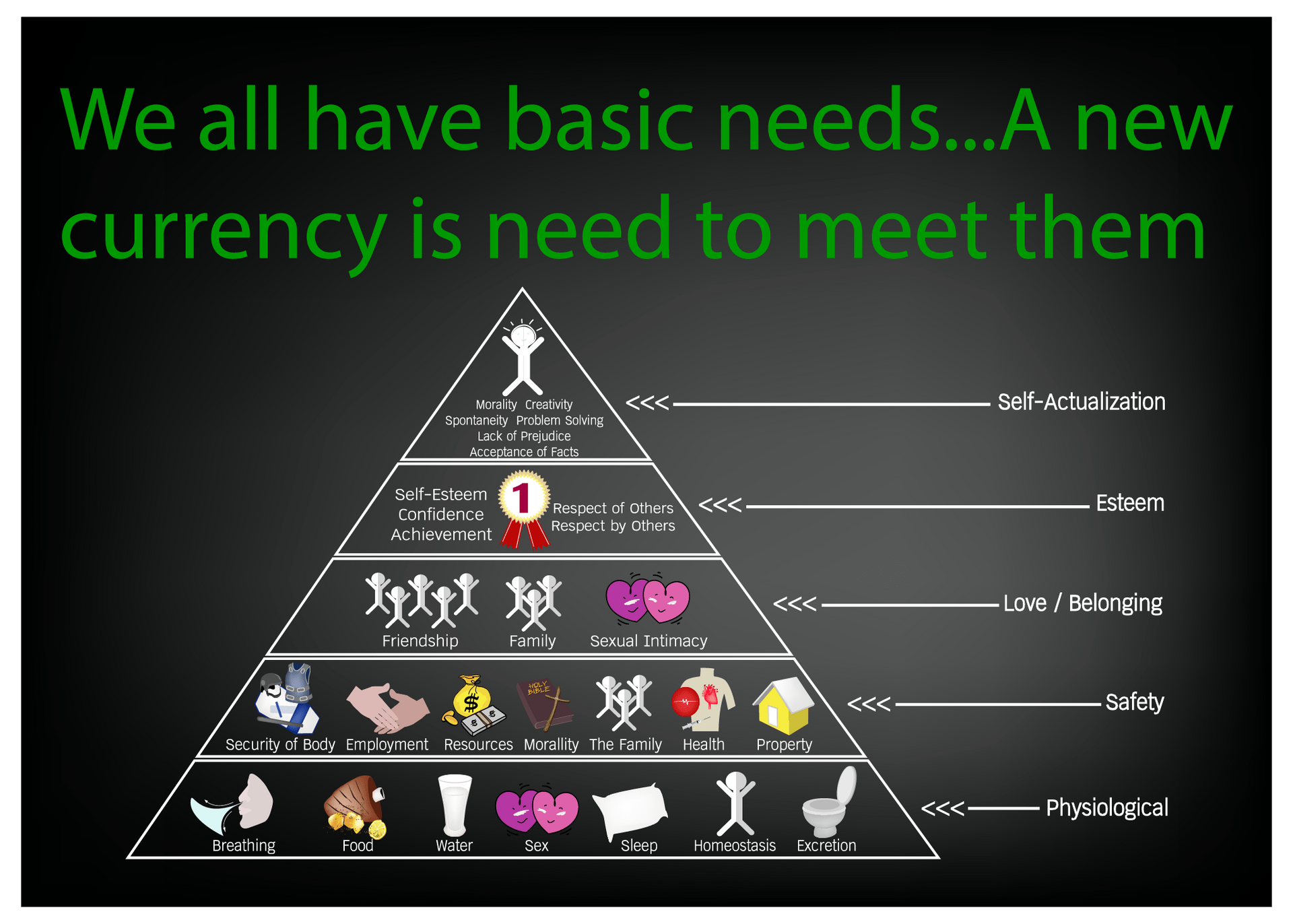
We all have basic needs a new currency is needed to meet them

This is why Renew the Earth suggests Energy Currency. A parallel, renewable, value stream that is dedicated to providing food, shelter, education and healthcare to every living human.

Empowering a secure Humanity that can in turn, protect Nature, not exploit it.   Energy Currency gets its value from our Human Energy. The Current of our interaction, work, play, invention, creativity, etc. Our anthropomorphic blend that is forming Earth to its needs and wants, is now a force of Nature.   By providing for Human survival needs, Energy Currency is in turn sustained through our works and interactions and then reinvested in Humanity, creating a renewable cycle that empowers all people.           

Needs are key.

They can only be provided by a value system that has no other objective. The survival of Humanity is inextricably connected to the survival of Nature, in its present form. Nature will be on Earth without us but settled into a different dynamic if we continue to deplete it. One that may not be hospitable to human life if we destroy this present balance and have to start all over again with a few hundred survivors. 

We need places of agreement. It is not enough to be secure in your own beliefs anymore, left or right. Division of societies and countries into opposing factions creates stagnation and amplifies dangers and fears. By thinking about what we all can agree upon and conversing on these things, every individual can be part of a significant shift in social dynamics. Our representatives won’t depolarize until they sense that citizens are seeking agreement. They take their cue from what they perceive is the mood amongst their constituents. This is how they get reelected. We change the course of social development, world wide, through our agreements.  We have all that we need to solve our present challenges.  Computers that track world wide commerce and can easily be tailored to track human needs, which can then be distributed from the most efficient locations with the most efficient means and with the most efficient production.

All this efficiency can be guaranteed because the profit motive has been removed. Energy Currency cannot be used for profit making, cannot be invested or saved, and will not create inflation. It is destroyed at the banks.  An Energy Currency debit card could be provided to every living individual that is loaded with the appropriate need values, (catered to the age and location of each person), and constantly reloaded, as services are used, at a predetermined dignified survival rate. This card can be presented and honored whenever a person requires basic needs. There is no stigma attached because everyone has access to EC and can use it or not use it. Providers will be reimbursed at the replacement value of what is provided. Meanwhile, profit economics continues in parallel doing business as usual.  

These are new ways to think about human survival. Instead of “dog eat dog” and “not enough for everyone”, each person is protected and their lives valued over profit. We are already using systems that provide vital services, like health care through Medicare for the elderly and education through public schools roads, garbage collection… These systems can be used as templates for providing all basic human needs; food, shelter, education and healthcare.  We need to enlarge our vision for the future. Profit economics has run its course and can serve us but not without a parallel moderating system that provides for basic human survival and the survival of Nature, Energy Currency.  

“You never change things by fighting the existing reality…To change something, build a new model that makes the existing model obsolete.”   Buckminster Fuller
April 28, 2026
Like an exotic jewel set in the archipelago of Indonesia, Bali glitters and enchants. The Balinese have retained their unique community through intense social/religious bonds, hard work, exceptional talent and great sacrifice through the centuries to become a beautiful, gentle and inspirational community. Now, because of these unique qualities and accomplishments, finally and fatally they have become a primary tourist attraction that presently dominates 80% of their economy. The irony is that this may be the thing that destroys an incredible place and its people that hundreds of years of oppression and wars did not. If they don't soon diversify and return to the trusted systems that meant survival for their society over more than a thousand years Bali will no longer be a wonder of the World. Their unique form of Hinduism understood the root of survival when their irrigation system, subak, was first built. It was defined as a religious object to be venerated and protected with prayer, with temples and maintained by priests. Rooted in the Balinese philosophy, Tri Hita Karana, the principle of achieving harmony between humans, nature and the divine. It was the source of the staple food, rice. Water came from lake Batur, in the crater of the extinct volcano Kintamani, irrigated the hand cleared and formed terraces of rice paddies that descend in beauty and function to the sea. Seedlings hand planted by the women, sheaves of rice attached to the ends of poles carried across the shoulders of the men to the storage huts simple activities, carried out over more than one thousand years, that meant survival for a society. And the ancient kings of Bali also came together to sanction the subak. Agreement between religion and state. A rare thing in history and in the present. So what is happening now? How is tourism threatening the survival of the Bali we have come to know and admire? Aren't people coming to praise and enjoy? Isn't that a good thing? It is not the intentions of the visitors, it is the structures built around tourism that make tourism possible, they have become destructive. Why are they destructive? The answer is water. Because of the demands of hotels and resorts for fresh water, the water table has dropped by around 60%. Into the void presses the salt water of the sea. Not only is the amount of fresh water that feeds the subak compromised it is threatened by salination and made unusable for rice growing. This situation is sometimes referred to as being caught between a rock and a hard place. The government needs to step in and limit or freeze new construction of resorts till a sustainable balance is found. Also, water use needs to be prioritized and rationed for essential use, the subak system as a primary user. Finally, the income from tourism must be distributed back to the Balinese people for their dignified survival and flourishing. The dependency on tourism has created an imbalance. Men can be seen sleeping rough in the parks. There is desperation in the eyes of the women who sell clothing and souvenirs in the outside stalls. The main profession encouraged for children is hospitality work. The majority of profit from tourism needs to be returned to the people. They have earned it, they have built what we admire, they have carried in their hands and hearts the unique social compromise that has survived to this day against impossible odds and now it is being challenged by economic forces, more subtle but no less aggressive and destructive than war. Susan Caumont
April 17, 2026
Sea days pass differently than land days. At sea the ocean and the ship's passengers are the changing features. Land life has extra distractions, vehicles, shops, museums, temples, churches, gardens, bird song, dogs barking, taxi drivers, venders, airplanes, the full extent of human activity. During sea days I prefer to observe the ocean. I am aware of the passengers; like being part of an extended family or small village where you know most of the people a little and a few well. But the opportunity to be on the water for long periods is special. Sometimes, when the ocean is calm, a criss-crossing pattern may be seen on the surface, a delicate weave of vibration. I wonder if marine life is creating it, communicating. Other times the water heaves and agitates like an angry crowd is running here and there under a silk sheet. We sail six days from Adelaide to Fremantle, for the most part we encounter easy swells on this trip. The ocean lets us pass with tranquil, breathing heaves up and down. When we arrive there is an art festival in progress downtown. Crowds of people have traveled by train from the suburbs. We walk in. Some streets are blocked, making way for displays of crafts, performers, food venders and pedestrians. People are all around, eating, talking, buying stuff and watching the performers. Clowns, singers and acrobats compete for attention and overhead huge soap bubbles float, generated by the children nearby. It is a perfect day and everyone is out to have a good time.
April 7, 2026
Our stop in Melbourne was only for a day. There are plans to return after we visit Tasmania, which is just south of Melbourne. When you look at a map you can see where the island broke from Australia, a ragged triangle torn from the continent. England brought their convicts here to establish a penal colony in 1803, (convict transport ended in 1851, 50 years later) the colony eventually became Hobart, the capital city. Convicts were brought by sail. All the way from England around the southernmost tip of Africa, Cape Agulhas. A cape historically known to clipper ship sailors as a significant hazard, notorious for mammoth rogue waves of up to 30 meters (100 feet). What could these unlucky people have done to be banished on such a dangerous trip and so far away to an “uncivilized” island? Turns out prostitution and unwed pregnancy was enough to get sent there if you were a woman. And being an orphan, if you were a child.
March 25, 2026
The yellow pilot boat is approaching. A pilot will be brought onboard to guide our ship through the harbor. As we progress, a stretch of islands pass us on the left then, the coastline, on both sides. Sailboats, white triangles against the dark blue water, shine in the distance. Cliffs drop sheer from the pastureland to the tan beaches. Dark green groves fill the crevasses. We cruise along under the dome of the sky. Soon we will be docked at Port Melbourne, Hobson's Bay, Australia. Living life onboard, traveling around the world, I feel like a spirit watching the living as they go about their activities. I am a temporary exhalation, undetected then gone. But their doings remain in my mind. Humans are so very busy, especially the young adults. It takes significant aging to bring on stillness and reflection. My obscurity can make me sentimental. I feel a general affection for anyone who passes. I saw a baby watching sea gulls eat the French fries that someone had tossed to them. I imagined her forming her own impressions of everything around and not yet named. I wished her well and hoped that the war would end soon.
March 12, 2026
The most important thing we have to do, now that we have re boarded our ship in downtown Sydney, is to increase the number of pages in our passports. Most countries will stamp a whole page and sometimes two. Our passports, though new, only had twenty eight pages. This will not be enough to get us around the world! So we made an appointment with the US Embassy, along with 50 other passengers, to address this issue by purchasing larger passport books which have 52 pages. The Embassy was new and modern, the employees good natured and efficient, considering that we descended on them all at once. We conducted our business in an orderly manner under the watchful eyes of the US President, Vice President and Secretary of State, whose framed photographs dominated the far wall.
February 23, 2026
After all our planning for Jeff's next operation and waiting out the days till we arrived in Cairns, Australia, we finally flew to the Sydney airport. It was evening when we got there and both of us were exhausted. We both thought why call an Uber, there are a bunch of taxis hanging around, just take one of them to the motel. That was a mistake. We ended up paying $100 for a 20 minute trip in no traffic. Uber would have been half, I found out later. Since then we have taken several Uber rides in electric cars. And they have been excellent experiences. Australia has been importing Chinese made electric cars. We got to ride in a BYD and Uber drivers like to talk. We conversed with a Japanese driver and an Indian driver, both men. Both had been in Australia about 15 years. They seemed to like being in the big city. Both agreed it is generally too expensive. The driver from Japan, his wife works in the hospital and they have children, he likes the flexibility of the job so he can be involved with school and activities. The Indian driver has a son and would like to return to India so his son can experience his homeland. We are resting at our motel and I am outside watching the wild cockatiels.
February 11, 2026
We have several sea days before we arrive again in Cairns, Australia. This means we will not see land for a while. The rhythm of sea days is very different from shore days. There are a variety of activities you can participate in. Almost anything you can imagine is being invented as a result of the variety of people onboard, some of whom want to duplicate the entertainments they enjoyed where they used to live.  This is a residential cruise ship so a lot of the passengers are onboard long-term, meaning many months or years or the rest of their lives. The longest stay, if you “buy” your cabin, is 15 years. When Jeff and I bought our cabin that was all that was offered. Now you can buy a cabin for 5 years. Each circumnavigation takes about three and one half years. We are going to try to stay onboard for at least one circumnavigation. Before the sea days began, we visited two of the islands of Tonga. At the first stop, people scuba dived over a reef right next to our ship
January 27, 2026
The float of cloud drifts and encircles a mountain leaving just the very top, a pointed witches cap poking through. These islands have the most magnificent mountains. They brood around the harbors, snagging the clouds that pass. No doubt they have inspired fantastic stories. The cloud shadows create chameleon-like changes on mountain surfaces, making them even more expressive than oceans that amuse themselves by hiding what they contain; mountains are hysterical by contrast. Always looking for attention. “Look. Look again!, what about this?” They may hold a pose for a while seeming docile, then you look up and they have disappeared. White mist covers just a grey suggestion, then suddenly black silhouettes like broken giant teeth rise defiantly. So much animation, millions of years after volcanic upheavals shook these mountains from the sea depths.
January 13, 2026
Medical emergencies all have a similar feeling. Intensity, urgency, a changed perception of time; only events and human encounters progress, time seems warped, unimportant. After several sleepless nights because Jeff was having difficulty peeing and he was beginning to have pain, he went to the onboard clinic to get catheterized. There were three attempts with successively larger catheters. This was painful and distressing for him, though he kept joking about it, “this is not good sex!” The attempts were unsuccessful. He was given pain killers and an ambulance met us at the dock for a 10 minute ambulance ride to the hospital. Jeff is an 80 year old man with an enlarged prostate so he normally has trouble peeing. But this time it stopped altogether and there was blood. We are waiting at the hospital for the urologist. Nurses and a general practitioner have spoken to us in English. Very kind, polite, casual and patient. The urologist arrives and talks with Jeff. He is going to get the operating room ready and put Jeff out. Then he can do the operation. We wait in our curtained off cubicle Jeff is lying on a bed. A woman who came with her husband, who has high blood pressure, is behind the curtain to the left of us. He had collapsed. She is reciting the Lord's Prayer and Hail Marys over and over in an emotional whisper. She is crying. A young man is in the cubicle to our right. He seems to have broken his arm. It is all wrapped up in white gauze. Earlier a man had been stung by something and ointment was applied. A pregnant woman has come in. This is a modest hospital, very basic, two floors. They have what they need. A few flies buzz lazily around, but most are killed by the electric device on the wall. A very slight smell of urine is in the air. We arrived here about 8:30. It is now 2:00. Jeff has had an ultrasound, blood pressure checks and an EKG. Now he is in a wheelchair waiting for the nurse to take him to an operating room. The waiting room has about 10 people waiting. About 50 chairs in all. Not terribly busy for a Saturday. Light and darker coffee colored skin, attractive, rounded features and large expressive eyes set apart the native population. They are only a little curious about us. There is no rushing here.
December 29, 2025
Papua, New Guinea.
More Posts