Chapter Five – Mexico (5/25)
Mexico, 5/5/25.
We take a shuttle into the town of Tapachula, $25.00 for 2 people.
A much longer trip than we expected. And the temperature is in the 90’s Fahrenheit. Along the way there is time to observe; houses made of concrete blocks with metal roofs, windows with no glass and entrances with no doors. Motorcycles improvised with seating arrangements to carry more than one person or an open structure to haul wood (for cooking?) and other necessities.
Bananas and mangoes are exported. Magnificent mango trees, 50 feet high, are visible from the road, disappearing into the distance in rows. When we get closer to town the traffic increases and suddenly we are behind an open police vehicle with two officers seated facing outward with assault rifles cradled in their arms. No expression on their faces. In the town we see more of the same. We are informed that they are keeping the people under control.
The town is very active with people moving in every direction. Like currents of blood in a circulatory system. We are in search of a hardware store. “La ferreteria.” I keep repeating this in my mind. Block after block of stores all around us, into the distance. We arrive where we were told to go, and don't see a hardware store. I asked a local man, “ La ferreteria?” He looks at me with a blank look. “Oh, You don't speak Spanish!” He gestures behind him.
We were standing right in front of it and didn't realize what it was. It is simply a long wall with all the hardware displayed on it and several men behind a shallow counter to take your order. Jeff found a salesman who spoke English.
“What are you doing here if you can't speak Spanish?” The salesman was from Long Island, NY.
He actually had what Jeff was looking for.
While we wait for the bus back to the ship we listen to men playing beautifully carved wooden xylophones.
The sounds of Tapachula's heartbeats.
At Sea
Acapulco, Mexico.
The anticipation of arrival. The experience of sighting land in the grey of early morning and watching it approach as light opens, is magical. Nothing there, then something then as distance shortens buildings are visible and the spell is broken. This fascination must be a throwback to the earliest sailing experiences. Sailors at sea for months with no land in sight, then there it is, shadowy grey on the horizon, a wild hope.
Acapulco has grown from a dozen dwellings, two or more churches and the beginnings of a fort to uncountable homes and buildings in little more than 400 years. The natural harbor that lured the Spanish here in the 1600’s is the main port of the city. There is a sense that building upon building has been constructed in order to climb as high as possible up the mountains. The dwellings are cubes of different sizes. Nothing, it seems, is ever removed just built on top of, climbing higher, and they seem to be attached to each other. Some places there are gaping dirt and concrete holes where buildings have collapsed. But the integrity remains. Like houses of cards held together with glue. (The devastation of hurricane Otis still remains after two years, contributing to the dismantled aspect of the city and distress of its people.)
A magnificent stone Spanish fort still stands, overlooking the harbor, cannons at the ready. It houses an excellent museum. Suddenly I realize that the present buildings have been arranged like the blocks of stone that form the old fort. One supporting the next and traveling organically around obstacles and existing boulders. Confining and supporting the land, it shelters an ever growing hive of humanity.
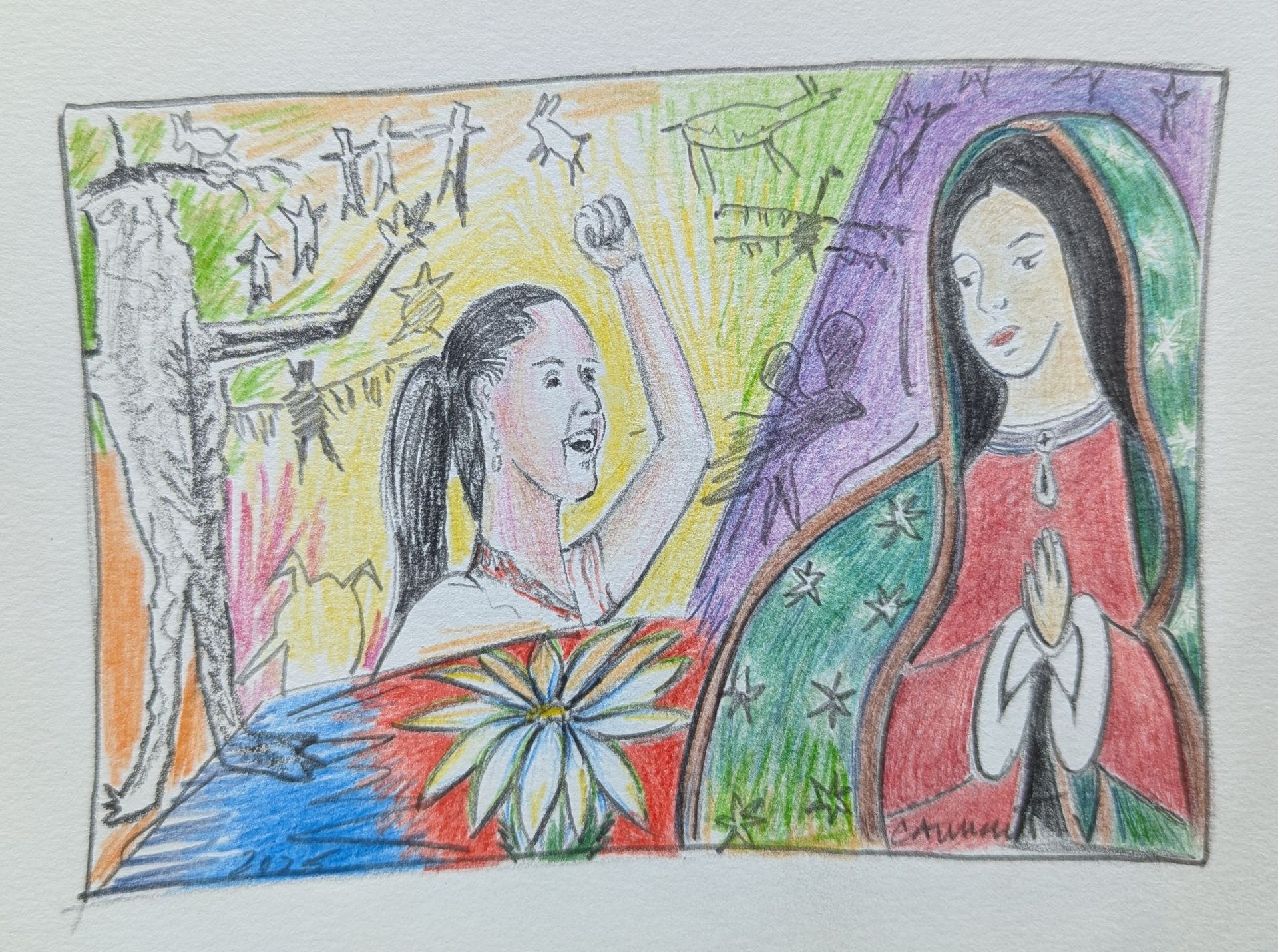
The President of Mexico, Claudia Sheinbaum visited Acapulco while our boat was docked there. She is much loved. “She is helping the people!”
A local man said.
Cries of “Presidanta Acapulco te ama.” “We love you!” Car horns echoed around the harbor as she passed with her motorcade. She is their wild hope.
A highly educated woman, President Sheinbaum has a PHD in physics with a special concentration in energy engineering. Her parents were politically active, they marched in demonstrations for human rights in their day. She has made progress with getting large solar arrays built in Mexico (the largest in the Americas opened in 2024).
At Sea
Manzanillo, Mexico 5/11/25
This is a well kept city. Very busy with lots of shops and restaurants. Colorful homes, worn out but maintained with pride. No garbage on the streets. It benefits from sport fishing for sailfish. There are tournaments every year. It has become an international tourist destination with fancy resorts, also a major shipping port.
At Sea
We are underway again, traveling at about 12 knots (approximately 12 mph) and we will arrive at Puerto Vallarta around 8:00 am.
I am sitting on the top deck waiting for the setting sun. I read that it is possible to see the ‘green flash’ when the sun disappears at the meeting of the sea and sky. And there it was. A green light flashed for just a second as the sun vanished! The lamplighter was on duty.
5/14/25, Puerto Vallarta, Mexico, arrival
Its coastline looks like Miami, Florida. High rise condos everywhere, a Mall and Walmart. Jeff had to have prescriptions filled so we walked to the Walmart. The maze designed for people on cruise ships made a 10 minute walk an hour long. The object was to make everyone walk past the shops and restaurants etc. and buy something.
At the Walmart we are greeted by 4 men. One of them says, “You are tourists, do you need some help?” I replied, “ It doesn't matter that we are tourists, every Walmart is the same, Worldwide!” He laughed. The pharmacy did not have what Jeff needed.
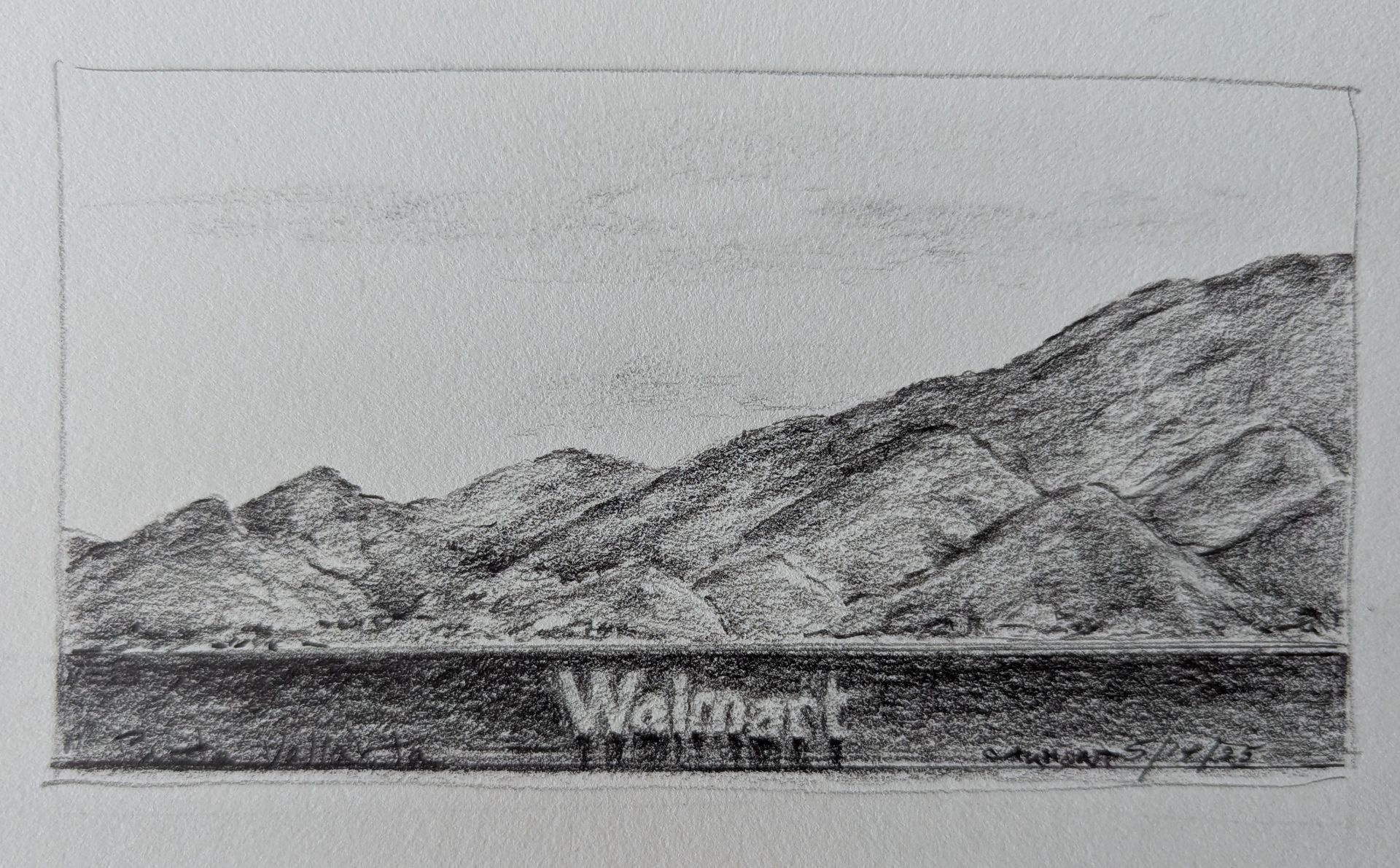
One interesting thing was a wild bird rescue, cobbled together with cages and chain link housing about 30 Macaws, a few hawks and a barn owl. It was located at the edge of a huge parking lot and gave the impression that the city wanted them to give up and leave. $2 to visit.
At Sea, 5/17/25
Mazatlan, Mexico. 5/16/25
This city does not display military presence like the previous cities we have visited.
We walked into town and found pleasant neighborhoods with wash lines on the roofs and images of saints and the Virgin Mary painted on walls along with some angry graffiti and a mural of a pod of dolphins. The quiet and charm are interrupted by truck traffic from the shipping port. The wealthier people move to the other side of the harbor and build their homes.
“Let it be known that nobody crossed my path without sharing my being. I plunged up to the neck into adversities that were not mine, Into all the sufferings of others.”
Pablo Neruda
At Sea
Topolobampo, Mexico 5/20/25
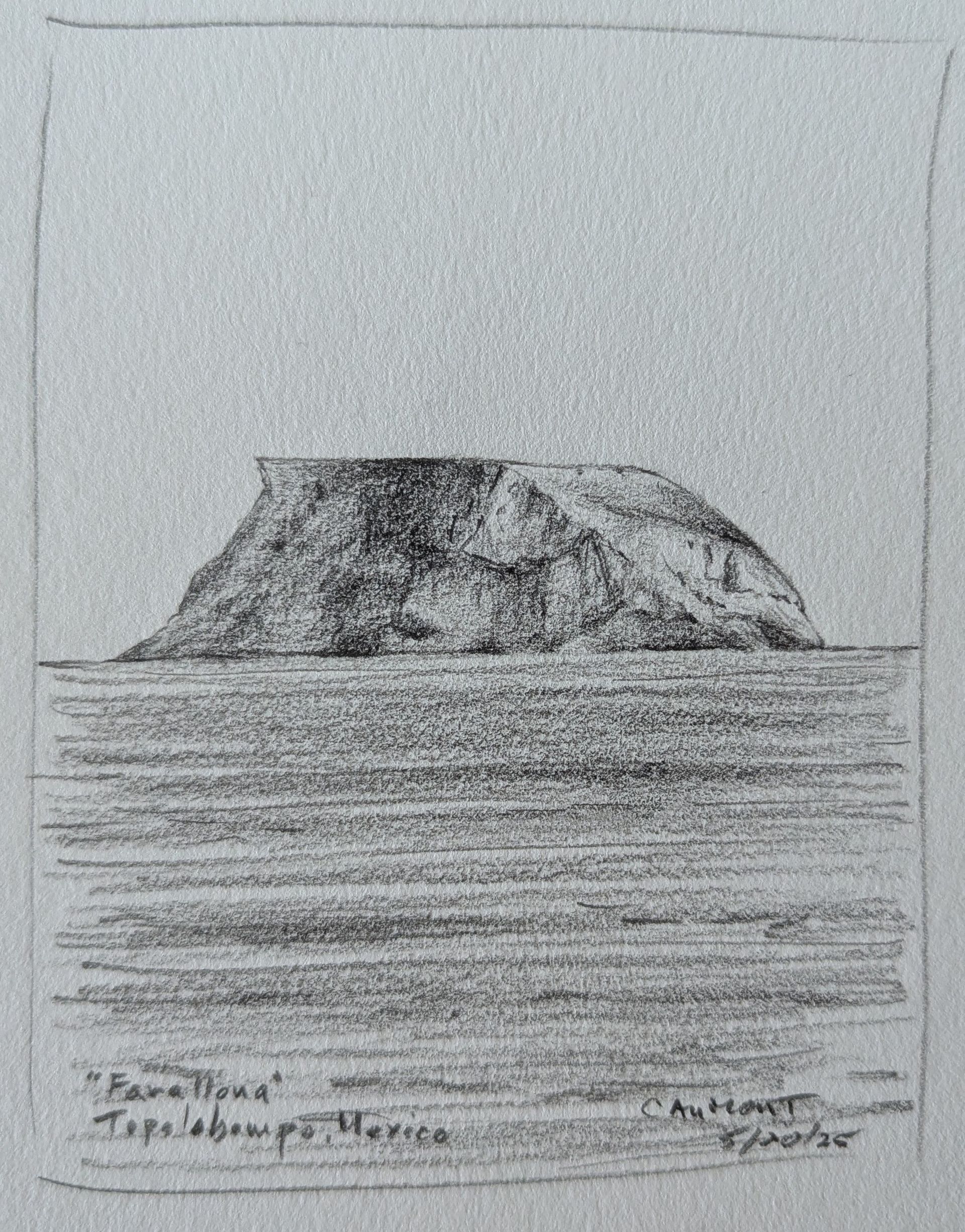
The approach is magnificent, we pass a massive white cube of stone gleaming in the early light like an iceberg, then the soft brown textures of Mexican mountains on either side appear as we approach the port, and grey stone cliffs rise behind them.
We hire a taxi to drive us around. The city is near where we dock but we are not allowed to walk through the shipping port.
Topolobampos brightly colored houses climb in Mexican fashion up its hillsides. We were told that the city will paint your house for you. The government will pay for it. Just choose a color. And people do.
A man jumps out, runs in front of our taxi to talk to someone he knows in a car in the next lane. He has a rubber eagle mask covering his whole head. Our driver says that it represents a soccer team that just won a match. He is like an animation of the eagle on the Mexican flag, racing around searching for a snake to devour. Is Mexico changing? Is it in search of a new center around which to form?
Juvaer, our driver, speaks English. He spent some years in NY. He was born and raised in Topolobampo. He still lives on the hillside. “It is a good life,” he said. He had three sons and put them all through college. He is retired from working for a fishing company. He owns two taxis. All his son's are doing well and live elsewhere,”more opportunity.” They did not come back.
If beauty and serenity, “A good life” were the things that make people stay, Topolobampo would be the perfect place.
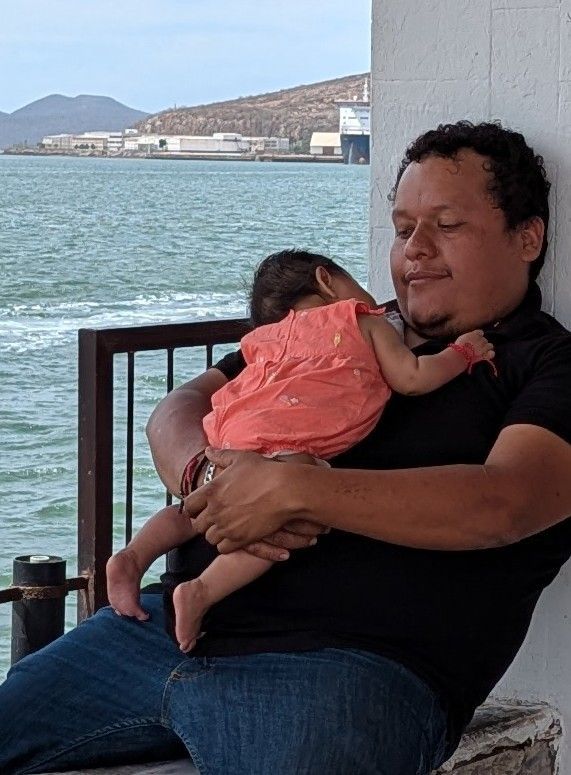
“Topolobampo, faintly sketched on the shores of sweet and naked maritime California, starry Mazatlan, night seaport, I hear the waves that pound your poverty and your constellations, the pulse of your passionate choirs, your somnambulistic heart that sings beneath the red nets of the moon.”
Pablo Neruda
At Sea
La Paz, 5/22/25
Another big city. Visitors are deposited from the bus in town like chum thrown into the water. The “sharks” surface immediately. “Where do you want to go? I will take you in my taxi.” “Tortillas are fresh, you want?” By now we have developed some evasion techniques, but it is impossible to be unaffected. You are a mark wherever you go, even if you speak Spanish and can compute the exchange rate in your head.
A refuge was the Museum of Art. Unlike most art museums this one shows the contemporary art of Mexican artists. It is not a dusty collection of “European” paintings. These are actual depictions of the dreams and nightmares of Mexico. The collective unconscious of a nation is on display. And the building that houses it is new, modern and clean. No fee.
At Sea
Cabo St Lucas, 5/23/25
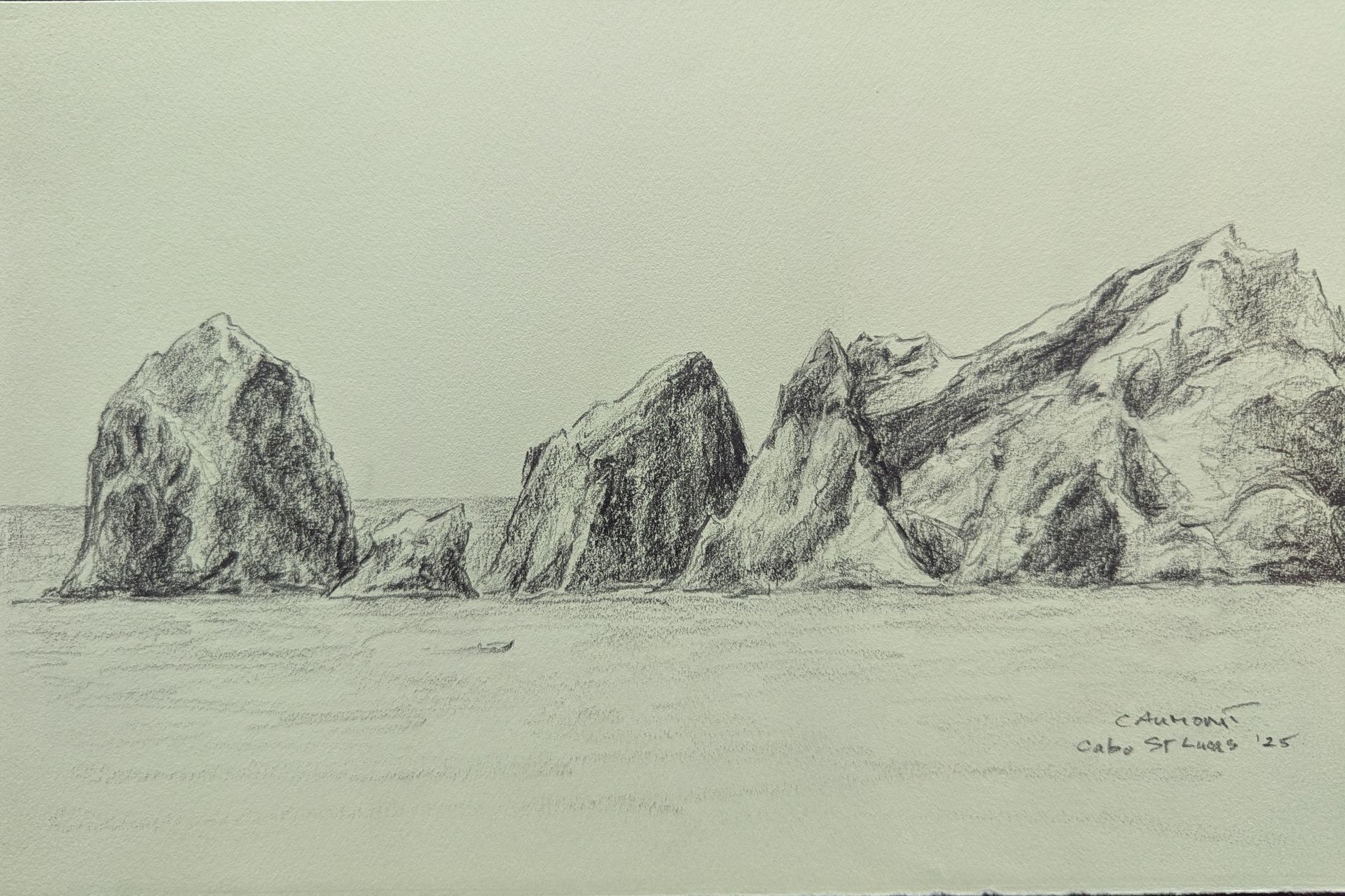
We anchor out in the lee of a high wall of rock islands. Tenders meet our ship to take passengers ashore. I am not tempted. Another overcrowded resort city on beautiful beaches under magnificent mountains. Jeff went ashore to interview a local person and take their picture. I will draw the mountains.
The result of Jeff's interview was similar to one he did in Topolobampo. Both individuals were young women, one a recent college graduate and the other a highschool student bound for college. He asked them what they thought of their new president. They both felt that she was concentrating too much on the poor and elderly. “What about me?” An older woman he interviewed in La Paz said something similar, “She is a Communist!” Why are people who want to help humanity dismissed? Have we been too hardened by past behaviors and wars to imagine something different?
Pre-industrial quaintness and beauty have been almost completely irradiated from the small and large cities we visited along the coast of Mexico. Market economy stresses that force people into purchasing and consuming modes that are beyond their earning abilities are evident everywhere. Yet, the blind men trying to describe what an elephant looks like from one small part they encountered were not accurate, as we know. There must be wonderful places still to be found in Mexico. Our little town where we come from nobody knows about or cares. It has unspoiled beauty.
Fortunately nothing can obscure the magnificent geology of Mexico’s coastlines. Rock mountains jut from the sea like giant petrified hands, huge white boulders surrounded by water in the middle of nowhere, sharp crested islands peer down at your insignificance and the vast blue dome of sky over everything. Just like what the native people saw thousands of years ago. All our building and crawling about on these surfaces and our pursuits in these skies are just a temporary distraction of our time.